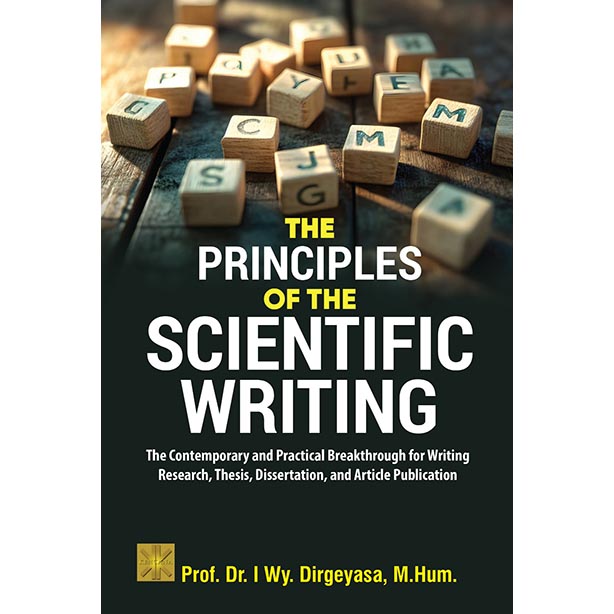
THE PRINCIPLES OF THE SCIENTIFIC WRITING: The Contemporary and Practical Breakthrough for Writing Research, Thesis, Dissertation, and Article Publication

Rp 150.000

Ebook WhatsApp

Deskripsi

“The book of The Principles of the Scientific Writing: the contemporary and practical breakthrough for writing research, thesis, dissertation, and article publication has been a game-changer for research writing in any discipline. The book provides clear guidance on content, structure, style, and clarity. It is also assumed that the book significantly enables to improve the writing skills, make papers more concise, readable, meaningful, and impactful. It is highly acclaimed book that can elevate the scientific writing quality and publication success as well for researchers, academics, and scientists.”

Prof. Dr. Sugiyono, M.Pd., a Professor in Research Methodology at Universitas Negeri Yogyakarta, Indonesia, and a MURI awarder in Research and Methodology

“Frankly speaking, this book is a treasure trove of practical advice for scientific writers. The author’s approach is truly engaging, accessible, and effective. The book can signficantly help the writers to refine their scientific writing skills. I’ve personally believe that it can improve the scientific writing significantly and impact fully.”

Aminudin Aziz, a Professor of Linguistics in Education University of Indonesia (UPI), and an Education and Culture Attaché at the Embassy of the Republic of Indonesia, London.

“As a non-native English speaker, I personally found this book to be incredibly helpful in improving  scientific writing skills. The author presents a holistic content perspective of the scientific writing resting on the question “what,” “why,” and “how” to write the essence of the scientitic writing holistically.  It definitely becomes trusted book because it also includes self-assessment for each chapter. I highly recommend this book to anyone looking to enhance their scientific  writing skills.”

Amrin Saragih, a emiritus Professor of Linguistics in English Department of State University of Medan, Indonesia.


Informasi Tambahan

Berat 350 gram
Halaman

290

Pengarang

Prof. Dr. I Wy. Dirgeyasa, M.Hum.

Ukuran

15,5 x 23

Cetakan

1

ISBN

978-634-263-233-8

Tahun Terbit

September 2026

Chapter 1 WRITING INTRODUCTION 1

  1. What is an Introduction? 1

  2. Why to Write an Introduction? 3

  3. What to Write in an Introduction? 4

  4. How to Write an Introduction? 13

  5. Case Studies 17

Chapter 2 WRITING RESEARCH PROBLEM 23

  1. What is the Research Problem? 23

  2. Why to Write the Research Problem? 26

  3. What are the Characteristics of Research Problem? 28

  4. What are the Types of Research Questions? 29

  5. How to Write Research Questions? 31

  6. What are Common Pitfalls of Writing Research Question? 34

  7. Case Studies 35

Chapter 3 WRITING RESEARCH OBJECTIVES 39

  1. What is the Research Objective? 39

  2. How are Research Aim and Objective Similar or Different? 40

  3. Why to Write Research Objective? 45

  4. How to Write Research Aim and Objective? 45

  5. Case Studies 47

Chapter 4 WRITING SIGNIFICANCE OF THE RESEARCH 51

  1. What is Research Significance? 51

  2. Why to Write the Significance of the Research Paper? 52

  3. What are the Domains of Research Significance? 53

  4. How to Write the Significance of the Research? 55

  5. Case Studies 56

Chapter 5 WRITING SCOPE OF THE RESEARCH 59

  1. What is the Scope of the Research? 59

  2. Why to Write the Scope of the Research? 61

  3. What Can be Scoped in the Research? 62

  4. How to Write Scope of the Research? 64

  5. Case Studies 65

Chapter 6 WRITING LITERATURE REVIEW 67

  1. What is a Literature Review? 67

  2. Why to Write a Literature Review? 69

  3. What is a Theoretical Review? 70

  4. Why to Write a Theoretical Review? 71

  5. How to Write a Theoretical Review? 72

  6. What to Do and not Do in Writing a Theoretical Review? 74

  7. Case Studies 76

Chapter 7 WRITING RELEVANT STUDIES 81

  1. What are Relevant Studies? 81

  2. Why to Write Relevant Studies? 82

  3. How to Present Relevant Studies? 84

  4. Where to Put Relevant Studies? 86

  5. What are the Principles of Writing Relevant Studies? 88

  6. Case Studies 90

Chapter 8 WRITING CONCEPTUAL FRAMEWORK 93

  1. What is a Conceptual Framework? 93

  2. Why to Write a Conceptual Framework? 97

  3. What are the Elements of a Conceptual Framework? 99

  4. How to Write the Conceptual Framework? 100

  5. Case Studies 103

Chapter 9 WRITING METHODOLOGY OF THE RESEARCH 107

  1. What is Methodology? 107

  2. What is the Difference between Method and Methodology? 110

  3. What are the Objectives of Research Methodology? 111

  4. What Should be Included in the Methodology? 113

  5. How are Components Structured in Methodology? 115

  6. What are Some Common Pitfalls in Methodology? 117

  7. Case Studies 119

Chapter 10 WRITING RESULTS OF THE RESEARCH 125

  1. What are the Results of a Research Paper? 125

  2. Why to Write the Results Section? 126

  3. How to Present the Results of a Research Paper? 127

  4. What are the Do’s and Do Not’s of Writing Results or Findings? 128

  5. Case Studies 129

Chapter 11 DISPLAYING DATA OF THE RESEARCH 133

  1. What are Data and Information? 133

  2. What is Data Display? 134

  3. Why to Display Data? 136

  4. What are the General Rules of Data Display? 137

  5. How to Display Data? 139

  6. Case Studies 153

Chapter 12 WRITING DISCUSSION 157

  1. What is a Discussion in a Research Paper? 157

  2. Why to Write the Discussion Section? 158

  3. What to Include in the Discussion Section? 159

  4. How to Write the Discussion? 161

  5. What to Do and What Not to Do in the Discussion Section? 164

  6. What are the Differences between Results and Discussion? 166

  7. Case Studies 167

Chapter 13 WRITING LIMITATIONS OF RESEARCH 171

  1. What is the Limitation of the Research Paper? 171

  2. Why to Write the Limitations of Research? 173

  3. What Factors Cause the Limitations of Research? 174

  4. How to Write Limitations of Research? 175

  5. Case Studies 177

Chapter 14 WRITING THE CONCLUSION 181

  1. What is the Conclusion of a Research Paper? 181

  2. Why to Write a Conclusion? 182

  3. How to Write a Conclusion? 182

  4. Case Studies 185

Chapter 15 WRITING IMPLICATIONS AND RECOMMENDATIONS 189

  1. Implication of the Research Paper 189

  2. Recommendation of the Research Paper 195

  3. The Smart Strategy for Writing Recommendations 198

  4. Case Studies 199

Chapter 16 WRITING THE ABSTRACT 203

  1. What is an Abstract? 203

  2. Why to Write the Abstract? 205

  3. What are the Components of the Abstract? 205

  4. How to Write the Abstract? 209

  5. Case Studies 210

Chapter 17 WRITING GAP OF THE RESEARCH 215

  1. What is a Research Gap? 215

  2. Why to Write the Research Gap? 216

  3. What are the Types of Research Gaps? 218

  4. How to Bridge a Research Gap? 219

  5. What are the Differences between a Research Gap and Research Problem? 221

  6. How to Write the Research Gap? 222

  7. Case Studies 225

Chapter 18 WRITING THE NOVELTY OF THE RESEARCH 229

  1. What is the Novelty of a Research Paper? 229

  2. Why to Write the Novelty of Research? 231

  3. What are the Domains of Novelty? 232

  4. What is the Level of Novelty? 234

  5. How to Identify the Novelty of Research? 236

  6. What are the Differences between Research Gap and Research Novelty? 237

  7. Case Studies 238

Chapter 19 THE STATE OF THE ART 243

  1. What is the State of the Art? 243

  2. What to Provide in the State of the Art of a Research Paper? 245

  3. What does the State of The Art explain? 246

  4. How do the SOTA, Research Gap, and Novelty Work in Research? 247

  5. Case Study 248

Chapter 20 WRITING ROAD MAP OF RESEARCH 251

  1. What is a Research Road Map? 251

  2. Why to Write a Research Road Map? 253

  3. What are the Principles of a Research Road Map? 254

  4. What are the Differences between a Research Road Map and a Research Flow Chart? 256

  5. Case Studies 257

REFERENCES 261

ABOUT THE AUTHOR 271

Ulasan

Belum ada ulasan.

Jadilah yang pertama memberikan ulasan “THE PRINCIPLES OF THE SCIENTIFIC WRITING: The Contemporary and Practical Breakthrough for Writing Research, Thesis, Dissertation, and Article Publication”

Alamat email Anda tidak akan dipublikasikan. Ruas yang wajib ditandai *